

Knowledge Is the Gateway to Inner Transformation
Inner awakening begins with understanding yourself, your thoughts, and the patterns that shape your inner world. Through knowledge, reflection, and consistent practice, you can develop deeper awareness, cultivate inner balance, and create meaningful transformation from within. Explore insights and practical guidance to support your journey towards a clearer, more conscious, and harmonious way of living.

Aligning with the Universe or the Divine
Many people reach a certain level of success in life stability, recognition, comfort yet still feel a quiet sense of incompleteness.
Something feels missing, though it’s difficult to name, this feeling often arises not from lack, but from misalignment.
When one’s true purpose remains undiscovered, the search turns outward, toward material achievements, pleasures, or distractions. These may offer momentary satisfaction, but they cannot fill an inner void that longs for meaning.
The spiritual path begins where this outer search ends.
It guides one inward, toward clarity, purpose, and alignment.
The first step on this path is surrender, surrendering the illusion of control and learning to accept life as it unfolds, while earnestly seeking deeper meaning.
With surrender, the struggle between the inner and outer worlds begins to soften, not because life suddenly becomes easy, but because we stop resisting the natural flow of existence.
The deeper purpose of this path is awakening into harmony with the Universe or the Divine.
From this harmony arises clarity about one’s true purpose and a sense of fulfilment that does not depend on external conditions.
True alignment is walking forward with awareness, guided by an inner sense of direction a quiet, steady pull toward what feels deeply authentic.
When we act from this space, fear loosens its grip.
Regret loses relevance.
The limitations and manipulations imposed by the outer world begin to dissolve, making space for clarity and inner peace.
Every birth carries a purpose.
The greatest challenge to lasting happiness is not failure or hardship, but the inability to recognize this purpose.
Once it is discovered and once one commits to it with sincerity effort begins to transform into ease.
Challenges may still arise, but they no longer feel obstructive.
Movement comes from truth rather than resistance.
The journey feels natural.
Opportunities align.
Support appears in unexpected ways.
The Universe does not respond to force.
It responds to truth.
And every step taken in alignment quietly invites grace leading toward a life that feels whole, meaningful, and deeply fulfilling.
Ultimate happiness is not something to be attained.
It is something to be realized.
Manifestation and the Inner World
Many people try to change their outer world and wonder why nothing shifts.
But manifestation doesn’t respond to effort alone it responds to the state of the inner world from which the effort arises.
Why does manifestation seem to work effortlessly for some, while for others it feels ineffective or even like a myth?
The answer lies not in the external world, but in the inner one.
What we experience outside is a reflection of our internal state.
Manifestation does not begin with desire alone, it begins with clarity, emotional stability, and inner alignment.
For those whose inner world is calm and energetically balanced, manifestation often appears effortless, their mind is relatively clear, their emotional state is stable, and their energy is not scattered, from this space, intentions naturally take form.
However, when the inner world is dominated by stress, anger, guilt, fear, or unresolved emotional pain, manifestation becomes difficult. A chaotic mind sends mixed signals, even strong desires fail to translate into reality when the inner state is fragmented.
This is also why manifestation may stop working for someone who once experienced success with it, after phases of trauma, prolonged stress, or depression can lower emotional energy and disturb inner clarity, when this happens, the same methods no longer produce the same results.
Some people persist and find that manifestation continues to work for them. Others try for a while, see no results, and conclude that it is not real. Yet manifestation itself is not a myth misalignment is the obstacle.
Yes, manifestation works.
But it works only when one has awareness and a certain degree of mastery over their inner state thoughts, emotions, and reactions.
If you observe people for whom manifestation seems natural, you will often notice a pattern, they tend to be emotionally lighter, generally positive, grateful for what they already have, and energetically present. This internal state is not accidental it is the foundation of their manifesting ability.
The true key is not forcing desires, but settling the inner chaos.
This does not happen overnight. It requires time, patience, and consistent practice. Across spiritual traditions and even modern psychological approaches, the emphasis remains the same, inner clarity precedes outer change.
In the Yogic tradition, mantra sadhana is one powerful method to uplift one’s energy and stabilize the mind. Meditation supports deeper awareness, helping one observe and gradually calm the inner world.
Both energy and clarity are essential.
When inner clarity develops, one begins to recognize what is truly needed not what society expects, not what comparison demands, but what genuinely resonates with the soul, manifestation that arises from this clarity is steady, grounded, and sustainable.
At this stage, manifestation is no longer driven by desperation or lack, but by alignment.
Understanding one’s internal state and consciously releasing unresolved emotions becomes essential. As resistance dissolves, intention gains strength.
Manifestation works for everyone.
But it works in its own time shaped by inner readiness, not external urgency.
Inner Stability the Real Spiritual Power
Spiritual power is often mistaken for intense experiences deep emotions, visions, or moments of bliss.
But experiences rise and fall.
Inner stability stays.
Inner stability means your mind does not collapse with every change in life, thoughts come, emotions move, situations shift yet you remain grounded.
This is not suppression or control.
It is the ability to not be pulled by every thought or reaction.
Ancient yogic systems valued stability over experiences because a trained, steady mind can face any situation without losing clarity, without this foundation, even the most powerful experiences fade quickly.
Inner stability is built slowly through consistent practice not through effort or excitement, but through discipline and repetition, at first, nothing dramatic happens. Over time, reactions soften and restlessness loses its grip.
Life does not become easier.
You become steadier.
That quiet steadiness unchanged by praise or pressure is real spiritual power.
Religious vs Spiritual
Many people confuse religious and spiritual, assuming they are the same.
In Sanātana Dharma, they are not opposing paths but different orientations, chosen based on what the seeker truly wants from life.
At the heart of this distinction lies a simple question:
Do you seek Bhukti or Mukti?
The Path of Religion: Bhukti
Religion addresses the needs of life within the world.
When a seeker desires material stability, prosperity, health, emotional happiness, family wellbeing, and divine protection, the religious path becomes meaningful. Rituals, prayers, vows, temple worship, and moral discipline create harmony between the individual and cosmic order .
This path does not deny worldly life. Instead, it refines it.
Religion supports Bhukti the enjoyment and fulfilment of life’s experiences, guided by dharma. It offers structure, faith, and reassurance, helping the seeker live a balanced and meaningful worldly life.
There is nothing inferior about this path.
It serves the majority of humanity and sustains society itself.
The Path of Spirituality: Mukti
Spirituality begins when the seeker asks a deeper question:
“Is this all there is?”
Here, the goal shifts from improving life to transcending identification with it. The seeker no longer seeks happiness from external conditions but looks inward to understand the nature of self, suffering, and freedom.
The spiritual path aims at Mukti liberation from attachment, ego, and the cycle of compulsive desire and suffering.
This path demands:
· inner discipline,
· detachment from outcomes,
· self-observation,
· and the courage to face discomfort without escape.
Unlike religion, spirituality does not promise comfort.
It promises truth.
Why the Spiritual Path Feels Harder
The spiritual path is comparatively difficult because it does not offer consolation it offers clarity.
It removes illusions rather than decorating them.
As attachments loosen, familiar identities dissolve. The seeker may feel alone, uncertain, or misunderstood. Yet this difficulty is not a flaw it is the price of freedom.
What is gained is not something new, but the removal of what was never truly you.
Choosing Consciously
Neither path is superior.
Each is appropriate at a different stage of inner maturity.
· Those seeking stability, harmony, and fulfilment should walk the religious path without guilt.
· Those seeking freedom, detachment, and self-realization must accept the spiritual path with patience and sincerity.
Confusion arises only when one seeks Mukti using tools meant for Bhukti or expects comfort from a path designed to dissolve comfort itself.
Final Reflection
Sanātana Dharma does not force a single destination.
It honors the seeker’s readiness.
First, life may ask you to live well.
Later, it may ask you to see clearly.
Bhukti prepares you for life.
Mukti frees you from bondage.
Both are sacred when chosen consciously.
The Types of Karma and What Happens When We Intervene in Another’s Karma
Karma is often misunderstood as reward and punishment.
In Sanātana Dharma, karma is neither moral judgment nor destiny carved in stone it is cause, continuity, and consequence.
Every action leaves an imprint.
Every imprint seeks completion.
To understand how karma works and why intervention matters we must first understand its types.
The Three Types of Karma
1. Sanchita Karma - Accumulated Karma
Sanchita is the vast storehouse of all karmic impressions accumulated across lifetimes.
It includes unresolved actions, tendencies, desires, fears, and attachments.
Think of it as a seed bank most of it dormant, waiting for the right conditions to sprout.
We do not experience all of Sanchita at once. That would be unbearable.
2. Prārabdha Karma — Active Karma
From the storehouse of Sanchita, a small portion becomes Prārabdha—the karma that is activated for this lifetime.
This determines:
· birth conditions,
· body and temperament,
· major life circumstances,
· unavoidable experiences.
Prārabdha must be lived through.
It cannot be avoided, only experienced with awareness or resistance.
This is where suffering often arises not from karma itself, but from fighting what has already ripened.
3. Āgāmī Karma Future Karma
Āgāmī karma is what we are creating right now through our choices, intentions, and actions.
Every reaction, every interference, every decision adds fresh impressions to the karmic flow.
This karma may bear fruit later in this life or in future ones.
What Happens When We Intervene in Another’s Karma?
Intervention is not always wrong but undiscerning intervention has consequences.
When someone is undergoing a karmic experience meant for learning, adaptation, or inner maturity, and we alter that experience unnecessarily, three things can happen:
1. Their learning is delayed
The experience may return later, often in a different or intensified form.
2. The karma shifts, it does not disappear
Karma cannot be destroyed by sympathy alone. When interrupted, its burden may partially transfer to the intervener.
3. New karma is created
The intention behind the intervention ego, fear, attachment, or validation determines the karmic residue for the helper.
This is why Sanātana Dharma emphasizes viveka (discernment) over impulsive compassion.
When Is Intervention Appropriate?
Intervention is justified when:
· there is immediate physical danger,
· basic survival is threatened,
· the person is incapable of responding consciously (children, unconscious states).
In such cases, helping does not bind karma it becomes dharma.
The problem arises when help is driven by discomfort with another’s suffering rather than clarity.
Karma Accumulation: How We Bind Ourselves
Karma accumulates not merely through action, but through identification.
· Helping with attachment binds.
· Helping for control binds.
· Helping to feel superior binds.
· Even suffering with resistance binds.
Freedom begins when action is performed without ownership.
This is why the Gītā emphasizes niṣkāma karma action without attachment to outcome.
The Subtle Shift from Compassion to Wisdom
True compassion does not rush to fix.
It observes, understands, and responds only when needed.
Wisdom asks:
Is this my karma to resolve or theirs to live through?
Sometimes the highest help is presence.
Sometimes it is silence.
Sometimes it is non-interference.
Karma is not cruel.
It is precise.
It teaches, balances, and completes what consciousness has left unfinished.
When we act with awareness, karma liberates.
When we interfere without clarity, karma accumulates.
The goal is not to avoid action but to act without bondage.
That is where karma ends and freedom begins.
Spending Time Wisely: The Forgotten Discipline
Time is the only resource that never returns.
Money can be earned again. Energy can be restored. Relationships can heal.
Time, once spent, is gone forever.
Yet most people spend it carelessly not because they lack discipline, but because they have never learned how to be with themselves.
The Rarity of Sitting with Oneself
One should be very careful with time, not by filling it, but by meeting it consciously.
The ability to sit with oneself without distraction, stimulation, or escape is a quiet superpower.
Everything else in life should be optional.
Most people confuse solitude with isolation.
Others mistake distraction for rest.
Sitting with oneself does not mean scrolling through social media, reading endlessly, watching videos, or keeping the mind occupied. These are refined forms of avoidance.
True solitude begins when nothing is happening and you remain comfortable.
Why Sitting with Yourself Feels Difficult
The mind resists stillness because stillness reveals.
When there is no noise to hide behind, unresolved thoughts, emotions, fears, and desires surface.
Those who cannot sit with themselves often seek constant company, stimulation, or validation. Those who can sit quietly become inwardly stable.
Stability is freedom.
Clarity Is a Natural Outcome
When you sit peacefully with yourself, clarity arises without effort.
You begin to see:
· which relationships nourish you and which drain you,
· which ambitions are borrowed and which are authentic,
· which roles you play out of fear,
· and which actions align with your deeper purpose.
There is no need to force decisions.
What aligns with your path naturally stays.
What does not, slowly falls away.
Life Simplifies on Its Own
When inner clarity grows, life reorganizes itself.
Friends, family, career, and relationships are no longer approached from confusion or compulsion, but from understanding. You stop reacting and start responding.
Time stops feeling scarce.
Energy stops leaking.
Choices become simpler.
Not because life becomes easier but because you become clearer.
A Practice, Not an Escape
Spending time wisely is not about withdrawal from life.
It is about meeting life from within.
Even a few minutes daily of sitting quietly without goals, inputs, or distractions reshapes perception. This is not productivity. This is alignment.
Those who master this do not rush.
They do not cling.
They do not waste time trying to become someone else.
They simply live in rhythm with themselves.
If you can sit peacefully with yourself,
everything else becomes optional not compulsory.
And when something is optional,
it can be chosen consciously.
Thoughts, Emotions, and Breath: The Silent Conversation Within
The body is not separate from the mind.
Every thought we entertain leaves an imprint on the body subtle or strong, immediate or delayed.
This relationship becomes easy to observe when we pay attention to the breath.
Breath as the Mirror of the Mind
Breath never lies.
When the mind is calm, the breath is slow and deep.
When fear arises, the breath becomes shallow.
With anger, it turns sharp and forceful.
With anxiety, it becomes irregular and restless.
Each emotional shift instantly changes the rhythm of breathing. Through this, we can directly experience how thoughts transform into physical responses.
The breath is the bridge where mind and body meet.
Emotions Leave a Physical Trace
Emotions are not abstract experiences.
They are biological and energetic events.
· Prolonged stress tightens muscles and exhausts the nervous system.
· Suppressed emotions disturb digestion and sleep.
· Repeated negative thought patterns weaken immunity and vitality.
Even so-called “positive” emotions, when excessive or uncontrolled, can overstimulate the system.
Balance—not suppression—is the key.
The Importance of Thought Awareness
Most people believe they control their thoughts.
In reality, thoughts often move on autopilot.
Becoming conscious of thoughts is the first step toward inner health.
Observation alone begins to weaken unnecessary mental noise.
A helpful practice is to gently categorize thoughts:
· Positive
· Negative
· Necessary
· Unnecessary
This simple clarity prevents the mind from wasting energy on what does not serve growth or stability.
Conscious Engagement Is Essential
Not every thought deserves attention.
Mental well-being is not achieved by stopping thoughts, but by choosing which ones to engage with.
Consciously nurturing positive and necessary thoughts supports:
· emotional balance,
· physical health,
· clearer decision-making,
· and inner steadiness.
Unnecessary and repetitive thoughts lose strength when they are seen but not fed.
Breath as a Regulating Tool
When awareness of thought is difficult, return to the breath.
Slowing the breath calms emotions.
Calm emotions soften thoughts.
Softened thoughts restore harmony in the body.
This is why breath awareness has been central to yogic practices for thousands of years not as technique, but as direct experience.
Thoughts shape emotions.
Emotions shape breath.
Breath shapes the body.
When we become conscious at any one of these levels, the entire system begins to realign.
Well-being is not something to be achieved in the future.
It is something to be practiced moment by moment within.
Thoughts, Consciousness, and Detachment
Most human suffering does not come from events themselves, but from our attachment to what the mind says about those events. To understand detachment, we must first understand the difference between thoughts and consciousness.
The Nature of Thoughts
Thoughts belong to the mind.
They arise from memory, conditioning, fear, desire, and past experience. Thoughts comment, judge, compare, and predict, they are constantly reacting to what happens inside and outside us.
Thoughts are useful tools but they are not reality itself.
The problem begins when we unconsciously identify ourselves with them, when every thought is taken personally, emotions rise and fall uncontrollably. Joy turns into anxiety, peace into restlessness, and clarity into confusion.
Attachment is born the moment we believe, “This thought is me.”
The Nature of Consciousness
Consciousness is different.
Consciousness is the awareness in which thoughts appear. It does not judge or react. It simply knows.
Thoughts come and go.
Emotions rise and fall.
Circumstances change.
Yet the awareness noticing all of this remains untouched.
Consciousness is not created by thinking it exists before thought, during thought, and after thought.
When this distinction becomes clear, a fundamental shift occurs.
Attachment and Emotional Disturbance
When we are attached to everything happening around us people, opinions, outcomes, identities we become emotionally vulnerable.
Praise inflates us.
Criticism wounds us.
Loss destabilizes us.
Change creates fear.
This is not because life is harsh, but because the mind clings.
Attachment binds us to reaction.
Detachment Through Conscious Observation
Detachment does not mean indifference or withdrawal from life.
Detachment means remaining present without emotional entanglement.
When consciousness observes the mind without interference, we naturally shift into observer mode. This is the first real transformation on the spiritual path.
In observation:
· thoughts lose authority,
· emotions pass without control,
· external events stop dictating inner state.
Life continues but suffering reduces.
Surrender: Another Name for Detachment
Many traditions call this shift surrender.
Surrender does not mean giving up action or responsibility. It means releasing the illusion of control over outcomes and identities.
When observation deepens, resistance dissolves. What remains is acceptance not passive, but clear and grounded.
This is not weakness.
This is inner strength.
The Beginning of Freedom
The moment you stop being affected by external events, you do not become cold you become free.
Freedom begins when you see thoughts as movements of the mind, not commands to be obeyed.
Detachment is not an achievement.
It is a byproduct of awareness.
And awareness is always available here and now.
Thoughts belong to the mind.
Awareness belongs to consciousness.
When you live as the thinker, you suffer.
When you live as the observer, you understand.
That understanding is the doorway to detachment.
And detachment is the doorway to peace.
Soul and Higher Consciousness
Across spiritual traditions, it is believed that the soul is the observer the silent witness behind thoughts, emotions, and experiences. It does not act in the way the mind acts, nor does it react like the emotions do. It simply observes and learns.
This capacity to observe is what allows experience to become understanding.
The Soul’s Journey
The soul is said to choose its journey its birth, circumstances, and challenges not as punishment or reward, but as opportunity.
Each life becomes a field of experience through which consciousness expands. Joy and suffering alike serve this purpose. Nothing is wasted. Everything contributes to growth.
From this view, life is not accidental. It is intentional learning.
A Fragment of Higher Consciousness
The soul is not separate from the whole.
It is understood as a small particle of Higher Consciousness individual in expression, universal in essence.
Just as a wave arises from the ocean without leaving it, the soul emerges from Higher Consciousness while remaining connected to it.
This connection is subtle, but always present.
The Role of Spiritual Practice
The purpose of certain spiritual practices is not escape, control, or perfection.
Their true aim is to strengthen the soul’s connection with Higher Consciousness.
When this connection deepens:
· clarity replaces confusion,
· purpose replaces restlessness,
· guidance arises without force.
Answers are no longer searched for externally. They are recognized internally.
Listening to the Inner Voice
The inner voice is not loud.
It does not argue or persuade.
To hear it, the noise of the mind must settle. Emotional turbulence, mental chatter, and external stimulation must soften.
This does not happen through suppression, but through awareness.
As inner noise subsides, intuition becomes clearer.
From Clarity to Stability
When clarity arises, calmness follows naturally.
Emotions no longer dominate.
Reactions slow down.
Decisions become simpler.
Emotional stability is not something to be cultivated directly it is a byproduct of alignment between the soul and Higher Consciousness.
The soul does not seek experience for pleasure alone.
It seeks experience for expansion.
As the connection with Higher Consciousness strengthens, life feels less chaotic and more guided.
Not because everything is controlled but because everything is understood.
And in that understanding, peace is found.
The Power of the Mind
In yogic wisdom, the mind is the key instrument of human life.
While the body supports our journey, it is the state of the mind that determines clarity, peace, and growth.
An untrained mind is easily disturbed by external events.
Through consistent practice, awareness, and self-observation, the mind becomes steady and aligned.
A disciplined mind supports wise decisions, emotional balance, and inner stability allowing one to remain grounded and centered in all situations.
This is the true power of the mind as understood in the yogic tradition.
The techings and practices in Yogic Science programs helps one discipline and master mind.
Sādhanā
Sādhanā is the inner process through which calmness, clarity, and emotional balance naturally arise.
As the mind settles, a deeper understanding of one’s true purpose begins to unfold.
Every seeker progresses at their own pace, shaped by sincerity, energy, and consistent practice.
When purpose becomes clear and one aligns with it fully, life gains meaning, fulfillment, and inner abundance.
In this state of alignment, the universe itself seems to guide each step.
Through sādhanā, one learns to live in harmony with the greater rhythm of existence.
Dhyāna
In the yogic tradition, dhyāna is a deeper state of inner absorption, beyond basic meditation.
Its role is to stabilize and refine the energies awakened through sādhanā, allowing them to integrate safely and harmoniously.
As practice matures, subtle vibrational currents arise and settle into balance.
Through regular dhyāna, the practitioner develops clarity, alignment, and the capacity to work consciously with intention (saṅkalpa).
These higher capacities, often referred to as siddhis, emerge naturally not as a goal, but as a byproduct of a sincere and disciplined spiritual path.
Thoughts
Observing, understanding, and filtering our thoughts is the first essential step in mastering the mind.
Every thought carries an emotion, and whether positive or negative, it leaves an imprint on our inner world.
When we become aware of our thoughts and begin choosing them consciously, the purification of the mind naturally begins.
Good thoughts nurture uplifting emotions harmful thoughts disturb our mental health and overall well-being.
Over time, these inner patterns shape the reality we experience outside.
“What we think, we become.”
When we stop feeding the mind with unnecessary or repetitive thoughts, the mind slowly becomes silent, clear, and balanced.
In that silence, true clarity and inner strength emerge.
The Inner Awakening Program include practices and teachings that helps in understanding and filtering thoughts.
What We Feed the Mind
In today’s digital world, the mind is constantly absorbing information often more than it can process.
Every emotion carried within this information, whether uplifting or draining, impacts the mind deeply.
This continuous intake shapes our thoughts, influences our emotions, and ultimately reflects in our behaviour and life experience.
Cultivating awareness of what we consume mentally, emotionally, and digitally is essential.
A clear, calm mind begins with conscious intake.
“What you think, You become.”
Practices and teachings routed in Yogic Tradition helps a practitioner to be aware.
Mantra as a Tool for Mind Purification and Focus
Mantra is more than sound
It is a vessel of intention, vibration, and transformative power. When used with devotion and consistency, it becomes a powerful tool for purifying the mind and cultivating deep focus.
The repetition of sacred syllables helps to cleanse the mental field of habitual thoughts, emotional clutter, and unconscious patterns. Like a gentle stream washing over a stone, mantra gradually smooths out mental agitation and restlessness.
Each utterance redirects the mind from distraction toward the present moment, training it to concentrate and rest in a single point of awareness. Over time, this focused repetition refines attention, stabilizes emotions, and leads to greater inner stillness.
Whether chanted aloud or repeated silently, mantra becomes a bridge between sound and silence, action and stillness—purifying the inner world and revealing the clarity and peace that lie beneath the surface of thought.
The Energetics of Mantra: Vibration, Frequency, and Healing
Mantras are not just spiritual tools, they are energetic codes that work on the subtle body through vibration and frequency.
Every sound carries a specific energetic signature, and when mantras are chanted with awareness, they begin to resonate within the body and mind, activating energy centers (chakras), balancing prana (life force), and dissolving energetic blockages. Ancient traditions recognized that sound is one of the most direct pathways to healing and transformation.
For instance, the mantra Om is said to contain the original vibration of the universe, aligning the practitioner with a state of harmony and oneness.
Scientific studies also show that repetitive chanting can shift brainwaves, lower stress hormones, and enhance emotional well-being.
Beyond the physiological, mantra chanting creates a protective energetic field, purifies the environment, and recalibrates the nervous system.
Through consistent practice, the body becomes more attuned, the mind more still, and the heart more open—revealing the innate intelligence and healing capacity within.
Benefits of Mantra Sadhana
When you begin your Sadhana, a quiet transformation unfolds.
Gradually, you may experience a deep sense of calmness, emotional stability, and inner peace states that gently guide you toward discovering your true purpose.
Each seeker’s journey is unique.
For some, clarity arises within days, for others, it may take weeks or months. The pace of this unfolding depends on one’s inner readiness, energy, sincerity, and the many subtle factors that shape the spiritual path.
When your true purpose becomes clear and you commit yourself to it, life begins to flow with greater ease. A sense of genuine happiness, fulfillment, and natural abundance emerges not as something pursued, but as something lived.
At this stage, the universe itself seems to guide you.
Your actions align effortlessly with the greater cosmic rhythm, and through Sadhana, you begin to move in harmony with the flow of existence.
The Yogi’s Path
In the yogic tradition, true transformation begins with mastery over the mind.
This is not achieved overnight, but unfolds gradually through consistent practice, discipline, and inner resilience.
As the mind becomes steady and refined, its influence naturally extends to the body.
A centered mind remains undisturbed by external circumstances, allowing clarity, balance, and inner stability to take root.
With mastery of the mind, the yogi gains increasing harmony over body and awareness, beginning to perceive life from a higher, more awakened state.
This gradual expansion of awareness is the essence of the yogi’s path transcending limitation and moving toward inner freedom.
Inner Awakening — A Path to Mastery of Mind and Life
The Inner Awakening Program is a holistic path designed to refine the mind and bring balance to everyday life.
It goes beyond meditation, offering practical methods to cultivate mental stability, emotional clarity, and inner resilience.
Drawing from yogic and Ayurvedic traditions, the program recognizes the deep relationship between mind and body.
As awareness grows and emotions are guided consciously, the mind becomes a powerful ally rather than a source of disturbance.
Through a structured 30-day journey, participants begin to experience life with greater calmness, clarity, and harmony.
This inner mastery is the foundation for a balanced and meaningful life.
The Power of Practice
Even a few minutes of daily mantra chanting can profoundly transform your energy, mood, and mental clarity. These sacred sounds, repeated with awareness and devotion, act like tuning forks for the mind and body, bringing harmony and balance. Whether whispered softly, spoken aloud, or chanted silently, mantras carry vibrations that can dissolve restlessness, uplift emotions, and create a deeper sense of presence. By weaving mantra practice into your daily routine—during your morning quiet time, while commuting, or before sleep—you gradually build a reservoir of calm and resilience. Over time, this simple, consistent practice becomes a powerful inner anchor, guiding you toward greater peace and spiritual connection.
Latest Teachings & Reflections
This program blends timeless wisdom from ancient traditions with modern insights, creating a holistic path for inner transformation. Through a carefully curated mix of philosophy, guided practices, and contemporary reflections, it offers tools to navigate the complexities of modern life with clarity and calm. Whether you’re exploring meditation, mindfulness, or deeper self-inquiry, these teachings invite you to align with your true self, awaken inner strength, and live with greater purpose and presence.
Sacred Sound and Silence
Explore the subtle dance between sound and silence—between the vibrating power of mantra and the stillness of meditation. Mantras awaken and refine our inner energy, guiding the mind toward focus and devotion, while silence offers space for integration, insight, and deep rest. Together, they form a powerful synergy: sound draws us inward, and silence reveals what lies within. By alternating between these two sacred states, we cultivate a deeper connection to the self, the present moment, and the source of all being. Let this rhythm of sound and silence become a gateway to inner peace and spiritual awakening.
The Art of Repetition with Awareness
Repetition is at the heart of all deep transformation, but when combined with awareness, it becomes a sacred art. In mantra sadhana, this principle is embodied through japa—the repeated chanting or silent recitation of a mantra. While the words may stay the same, each repetition becomes an opportunity to deepen presence, refine intention, and align with the mantra’s vibration. Without awareness, repetition can become mechanical; with awareness, it becomes meditative and powerful. This practice trains the mind to return again and again to the present moment, cultivating stillness, devotion, and clarity. Over time, repetition with awareness dissolves mental noise, strengthens focus, and opens the door to inner silence—where the mantra begins to chant itself, and the practitioner merges with the sacred sound.
Mantra as a Tool for Mind Purification and Focus
Mantra is more than sound—it is a vessel of intention, vibration, and transformative power. When used with devotion and consistency, it becomes a powerful tool for purifying the mind and cultivating deep focus. The repetition of sacred syllables helps to cleanse the mental field of habitual thoughts, emotional clutter, and unconscious patterns. Like a gentle stream washing over a stone, mantra gradually smooths out mental agitation and restlessness. Each utterance redirects the mind from distraction toward the present moment, training it to concentrate and rest in a single point of awareness. Over time, this focused repetition refines attention, stabilizes emotions, and leads to greater inner stillness. Whether chanted aloud or repeated silently, mantra becomes a bridge between sound and silence, action and stillness—purifying the inner world and revealing the clarity and peace that lie beneath the surface of thought.
The Energetics of Mantra: Vibration, Frequency, and Healing
Mantra is more than sound—it is a vessel of intention, vibration, and transformative power. When used with devotion and consistency, it becomes a powerful tool for purifying the mind and cultivating deep focus. The repetition of sacred syllables helps to cleanse the mental field of habitual thoughts, emotional clutter, and unconscious patterns. Like a gentle stream washing over a stone, mantra gradually smooths out mental agitation and restlessness. Each utterance redirects the mind from distraction toward the present moment, training it to concentrate and rest in a single point of awareness. Over time, this focused repetition refines attention, stabilizes emotions, and leads to greater inner stillness. Whether chanted aloud or repeated silently, mantra becomes a bridge between sound and silence, action and stillness—purifying the inner world and revealing the clarity and peace that lie beneath the surface of thought.
YogicScience India
At YogicScience India, we bridge the gap between 5,000-year-old Vedic insights and the psychological demands of the modern world. We don't offer abstract theories; we provide a practical tools for emotional survival and mental clarity.
" The power of the universe lies dormant in every human soul, ready to be awakened. "
Books
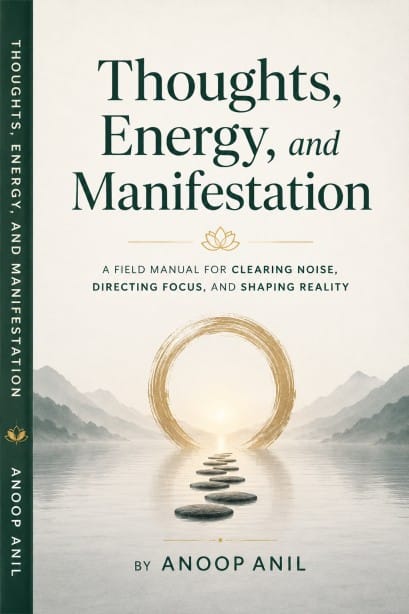
THOUGHTS, ENERGY, AND MANIFESTATION
A Field Manual for Clearing Noise, Directing Focus, and Shaping Reality


YogicScience was founded with a single purpose, to make ancient Vedic wisdom accessible to modern seekers, in its purest form, as traditionally practiced in ashrams.
info@yogicscienceindia.com | +91 89217 76860 | YogicScience India | Privacy Policy | Refund Policy | Terms of Use
© 2026 YogicScience India . All rights reserved.
All content on this website, including text, images, graphics, code, and other materials, is the intellectual property of YogicScience India and is protected under the Copyright Act, 1957. Unauthorized use or reproduction is strictly prohibited.